Nedokončené příběhy

Následující text byl zveřejněn v časopise Vesmír 2012/5: 305–307

Reakci Petra Pokorného najdete ve stejném čísle Vesmír 2012/5: 307–309

Další texty ke vzniklé kauze najdete zejména na webu Tomáše Herbena:
Krása syntézy - a čí že jsou ta data?
Malý český Vesmír, ale náš: je česká vědecká komunita schopna reflexe?

Nově: A zde je zveřejněno stanovisko Komise pro etiku vědecké práce v AV ČR

Úvahy nad publikací Neklidné časy – (P. Pokorný, vydalo nakladatelství Dokořán 2011)
Dagmar Dreslerová - Alžběta Danielisová - Petr Kuneš

Soil phosphorus as a control of productivity and openness in temperate interglacial forest ecosystems

Final version of this article was published in Journal of Biogeography, 38, 2150–2164 (2011).

by Petr Kuneš, Bent Vad Odgaard and Marie-José Gaillard

Abstract

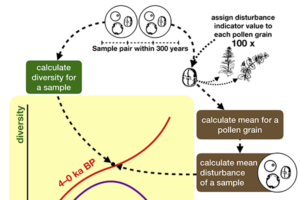
Observations of long chronosequences in forest ecosystems show that, after some millennia of build-up, biomass declines in relation to the slow depletion of soil phosphorus. Plants that dominate during this period of soil impoverishment have specialized strategies for P acquisition, including ectomycorrhiza or root clusters. We use quantitative, pollen-based reconstructions of regional vegetation in four Quaternary warm stages (Holocene, Eemian, Holsteinian, Harreskovian) to test whether inferred forest cover and productivity changes are consistent with long-term modification of soil nutrient pools. Location: Southern Scandinavia (Denmark, southern Sweden). The REVEALS model was used to estimate regional vegetation abundances of 25 pollen-type-equivalent taxa from pollen records of large sedimentary basins in southernmost Scandinavia. Based on the estimated regional vegetation, we then calculated time-series of Ellenberg indicator values for L (light), R (soil reaction) and N (a productivity proxy). We classified the vegetation records into distinct phases and compared these phases and the samples using hierarchical clustering and ordination.

All three interglacials developed coniferous or mixed forests. However, pure deciduous forests were never reached during the Holsteinian, while pure coniferous forests never developed in the Holocene. Above-ground productivity was inferred to be low initially, peaking in the first third of the warm stages and then slowly declining (except during the Holocene). Dominant trees of the post-peak phases all had ectomycorrhiza as a strategy for P acquisition, indicating that easily accessible P pools had become depleted. Increases in fire regimes may have amplified the inferred final drop in productivity. Mid/late Holocene productivity changes were much influenced by agricultural activities.

REVEALS vegetation estimates combined with Ellenberg indicator values suggest a consistent pattern in warm stages of initially rising productivity, followed by a long and slow decline. The P-acquisition strategies of dominant trees indicate that the decline reflects increasing P depletion of soils.

2008: Předneolitická krajina, vegetace a role moderního člověka ve střední Evropě

Kuneš, P. (2008) Předneolitická krajina, vegetace a role moderního člověka ve střední Evropě [Pre-Neolithic landscape, vegetation and a role of modern humans in Central Europe]. Živa, 56, 146–150. [in Czech]

Zde je ke stažení a přečtení článek napsaný pro časopis Živa. Jde v podstatě o souhrn bádání v češtině v rámci mé disertační práce.

Článek získal ocenění Purkyňovu cenu za nejlepší článek v kategorii nad 30 let v roce 2008.

 
fotografie z předávání cen Živy 2009

Ph.D. thesis – Petr Kuneš

Human-driven and natural vegetation changes of the last glacial and early Holocene

Dramatic changes occurred in global climates during the period of the last glacial and at the beginning of the Holocene. The major part of the time is evidenced for general climatic instability, which largely affected vegetation as well as human populations. Considering the fact that hunter-gatherers were an inseparable part of natural ecosystems at that time, we may better uncover their living strategies, resources and dynamics with detailed understanding of the vegetation distribution and development.

Content: